
What Is the Difference Between Traditional Dental Bridges and Implant-Supported Bridges?

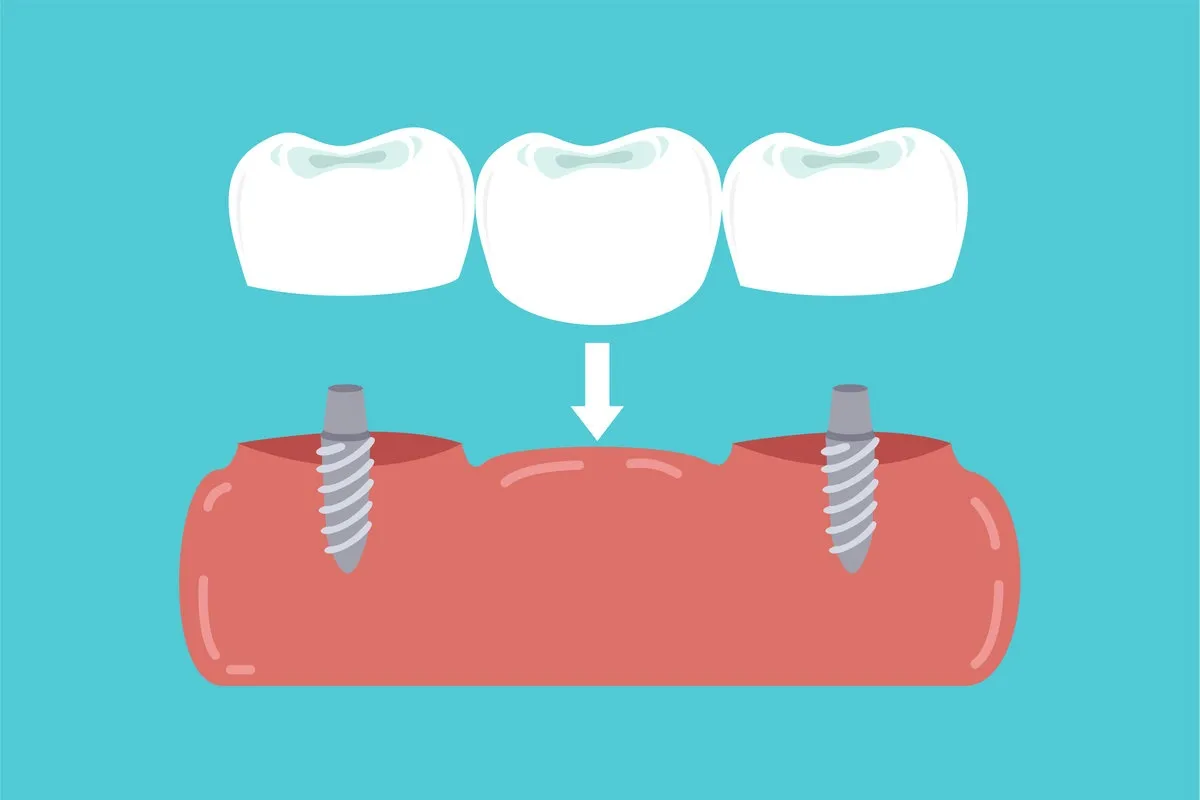
implants in gums supported dental bridge

When a tooth goes missing, the gap it leaves behind does more than affect your appearance. Over time, neighboring teeth can begin to shift, chewing can become uneven, and the jawbone underneath may start to deteriorate without the stimulation a tooth root provides. For patients exploring tooth replacement options, two of the most common choices are traditional dental bridges and implant-supported bridges. Each approach restores your smile, but they work in fundamentally different ways, and understanding those differences is key to choosing the right path forward.

At Distinctive Dentistry by Mullens & Nguyen, our team guides patients through every stage of the tooth replacement process. Dr. Mullens brings more than 35 years of experience to every consultation, and as a Fellow of the American College of Dentists, he approaches each case with a commitment to comprehensive, thoughtful care. Whether a patient is a candidate for a traditional bridge or ready to explore the benefits of dental implants in Jacksonville, we take the time to evaluate each situation individually and explain all available options clearly.

How a Traditional Dental Bridge Works

A traditional dental bridge is one of the most established methods for replacing one or more consecutive missing teeth. The restoration consists of a pontic, which is an artificial tooth, suspended between two dental crowns. Those crowns are placed over the healthy natural teeth on either side of the gap, known as abutment teeth, to anchor the bridge securely in place.

The Process and Its Trade-Offs

The placement process for a traditional bridge typically requires two appointments and involves reshaping the abutment teeth to accommodate the crowns. This is a key limitation of the traditional approach: healthy, structurally sound teeth must be filed down to support the restoration. While the resulting bridge looks natural and restores chewing function effectively, the alteration of adjacent teeth is permanent. 

Another consideration with traditional bridges is their relationship to the jawbone. Because a traditional bridge sits above the gumline and relies on the crowns for support rather than being implanted into the bone, it does not stimulate the jawbone beneath the gap. Over time, that area of bone can gradually recede, which may affect the surrounding teeth and the fit of the bridge itself.

How an Implant-Supported Bridge Works

An implant-supported bridge replaces the missing teeth in the same visible way as a traditional bridge, but the underlying foundation is entirely different. Instead of relying on adjacent natural teeth for support, an implant-supported bridge is anchored by titanium posts that are surgically placed directly into the jawbone. These posts function like artificial tooth roots, fusing with the surrounding bone through a process called osseointegration.

The Advantages of Implant Support

Because the titanium posts integrate with the jawbone, implant-supported bridges actively stimulate bone tissue, helping to prevent the bone loss that commonly follows tooth extraction. A 2023 review published in the National Institutes of Health’s PubMed Central found that implant therapy is considered a predictable and reliable rehabilitation method in most clinical scenarios, with growing evidence supporting its long-term outcomes. This bone-preserving quality is one of the most significant advantages implant-supported bridges offer over their traditional counterparts.

Implant-supported bridges also do not require the alteration of any surrounding natural teeth, preserving more of the healthy dentition already in place. The result is a restoration that closely mimics both the function and the structure of natural teeth. Patients often report that implant-supported bridges feel more secure during chewing and speaking, with less worry about movement or fit changes over time. For patients missing a single tooth in a particular area, single-tooth implant options may provide an even more targeted solution.

Choosing the Right Option for Your Smile
Distinctive Feb Blog Graphic Choosing the Right Option for Your Smile

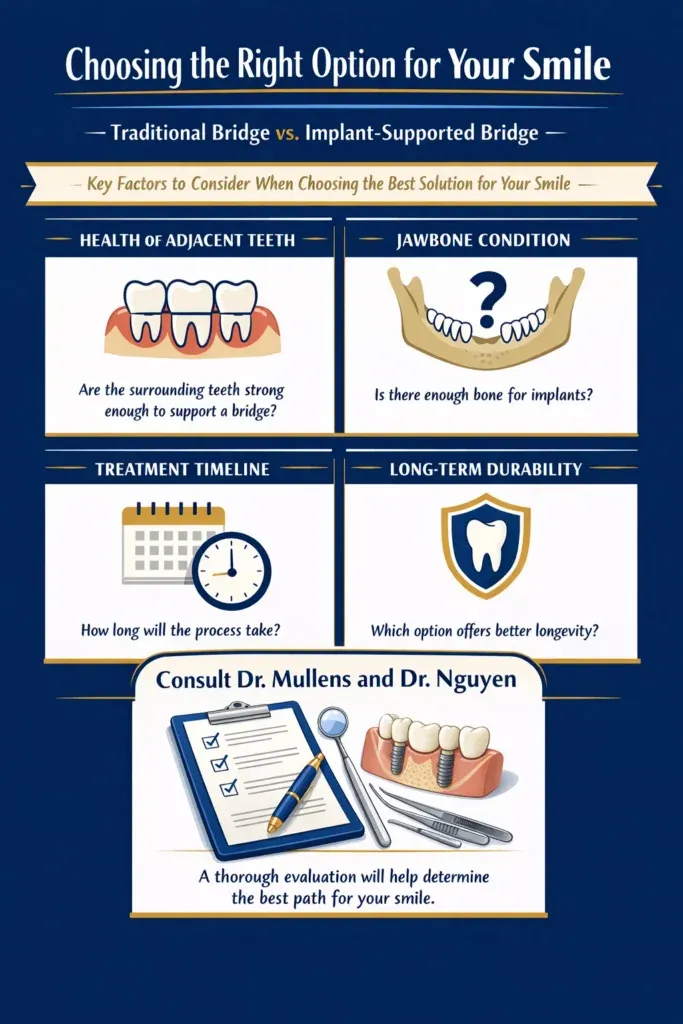
Deciding between a traditional bridge and an implant-supported bridge depends on several individual factors. These include the overall health of surrounding teeth, the condition of the jawbone, the patient’s medical history, and long-term goals for oral health. Some patients may prefer the shorter treatment timeline of a traditional bridge, while others may prioritize the bone preservation and longevity associated with implant support.

There is no single answer that applies to every patient, which is why a thorough consultation is always the starting point. Key considerations often include:

  • Whether the adjacent teeth are healthy enough to serve as abutment teeth for a traditional bridge without compromising their integrity
  • Whether adequate jawbone density exists to support implant placement, or whether a bone graft may be needed first
  • The overall treatment timeline, as implant-supported bridges involve a healing period for osseointegration that can span several months
  • Long-term maintenance and durability, including how each option holds up over time with proper care

Both options can produce beautiful, functional results when placed correctly, but only a dentist familiar with your full oral health picture can determine which path is best suited for your needs.

Choose Distinctive Dentistry by Mullens & Nguyen for Your Tooth Replacement

Replacing a missing tooth is one of the most impactful decisions you can make for the long-term health of your smile, and having the right team by your side makes all the difference. At Distinctive Dentistry by Mullens & Nguyen, Dr. Mullens and Dr. Nguyen bring decades of combined experience and a genuine commitment to personalized care, treating every patient the way they would treat a member of their own family. Our state-of-the-art Jacksonville facility is equipped with advanced diagnostic technology, including the Sirona CBCT system for precise 3D imaging, to ensure that every treatment recommendation is grounded in a thorough, accurate assessment of your unique anatomy.

Whether you are exploring a traditional bridge or want to learn more about implant-supported options, we are here to answer your questions and help you make a confident, informed decision. Request an appointment today, and let us help you take the next step toward a complete, healthy smile.

Office Hours

8:00 am – 5:00 pm
8:00 am – 5:00 pm
8:00 am – 5:00 pm
8:00 am – 5:00 pm
8:00 am – 11:30 am

Something Stuck Between the Teeth

If you have any food debris or an object stuck between your teeth, don’t try to remove it with a toothpick or any sharp objects, as this could damage your gums. Typically, gently flossing around the tooth and rinsing your mouth with saltwater can help dislodge it. However, if you’re not having any luck, you can also give our office a call. Our dental hygienists have all of the necessary tools to safely remove the debris.

Jaw Pain

Is Jaw Pain a Dental Emergency? Lockjaw, jaw tension, and pain are just a few of the many different types of jaw pain. If your discomfort is chronic, our team can help you determine the underlying cause of it and refer you to a specialist if necessary. However, if your pain is a result of an impact, visit your local emergency room.

How You Should Handle Jaw Pain: Our team is happy to provide you with further guidance over the phone if you’re unsure of where to go for help. You can place an ice pack on the outside of your face to relieve any discomfort.

How We Treat Jaw Pain: If you believe your jaw is broken, dislocated, or damaged due to trauma, visit your local ER immediately. If it’s a reoccurring issue, our team can help you determine best next steps for finding relief after conducting an examination.

Injury to the Gums, Lips, or Tongue

Is an Injury to the Gums, Lips, or Tongue a Dental Emergency?  If your oral injury doesn’t stop bleeding after 10 minutes, you may need to go to the emergency room. Or, if you’re conflicted about what to do, give our office a call and our team can help.

How You Should Handle an Injury to the Gums, Lips, or Tongue: Oral wounds can bleed a lot, and when the blood mixes with the saliva, it can make the injury look a lot worse than it is. You can stop the bleeding by using a clean washcloth or piece of gauze and pressing it against the cut. A cold compress can help to reduce any swelling that may occur.

How We Treat Injuries to the Gums, Lips, or Tongue: Our team typically doesn’t see patients for injuries. If you require stitches or the bleeding doesn’t stop within 10 minutes of placing pressure on it, visit your local emergency room.

Loose Permanent Tooth

Is a Loose Permanent Tooth a Dental Emergency? If your tooth is wiggling in its socket or partially dislodged, try to get to our office as soon as possible to prevent any further damage. If you’re experiencing pain, our team can provide you with first aid guidance over the phone.

How You Should Handle Loose Permanent Teeth: Avoid touching your tooth and eating any foods (especially those that are chewy or sticky), and rinse your mouth with lukewarm saltwater to remove any debris and cleanse the area. Avoid flossing or brushing your teeth until you’re able to see us.

How We Treat Loose Permanent Teeth: If your tooth has become partially dislodged due to impact, our team may be able to salvage it and see if the roots are able to re-fuse with the bone. In the case that your tooth can’t be saved, we may recommend an extraction and replacement with a dental implant or bridge.

Broken Denture

Is My Broken Denture a Dental Emergency? Whether your denture has broken to the point of it being unwearable or it just has a crack, you should never wear a damaged prosthetic. It can lead to irritation of the oral tissues in addition to jaw discomfort. If you have existing teeth and try to wear your damaged denture, it could also harm those teeth. Call our office immediately so our team can assess your prosthetic.

How You Should Handle a Broken Denture: Although your local department store likely sells a denture repair kit, do not try to superglue or repair your own dentures. The best option in this scenario is to see a professional as soon as possible.

How We Treat Broken Dentures: Our team will examine your dentures and see if we’re able to repair them. If they’re damaged beyond repair, we can start the process of replacing them for you.

Lost Filling or Crown

Is a Lost Filling or Crown a Dental Emergency? Yes, both of these situations warrant an immediate call to our Jacksonville dental office. That way, we can repair or replace your restoration as quickly as possible.

How You Should Handle a Lost Filling or Crown In addition to reaching out to us to schedule an appointment, we recommend not eating anything crunchy, hard, or sticky. Additionally, keep your restoration somewhere safe, like a small, clean container.

How We Treat Lost Fillings or Crowns There are some cases where we can re-cement your restoration back in place, like if your dental crown is relatively new and in good condition. Other times, our only option is to replace your dental crown or filling with a new one.

Knocked-Out Tooth

Is My Knocked-Out Tooth a Dental Emergency? Since this dental injury can cause a significant amount of pain and there is only a small window of time where we can save your tooth (about 60 minutes), the answer is “yes!” So, don’t hesitate – contact our Jacksonville dental team right away to schedule an emergency appointment.

How You Should Handle a Knocked-Out Tooth Calling us is an important first step. This ensures that we can schedule an appointment for you with one of our dedicated emergency dentists right away. Plus, it allows us to guide you through the process of preserving the root of your tooth – whether that’s by placing it back in its socket or putting it in a clean container filled with milk.

How We Treat Knocked-Out Teeth Fortunately, a knocked-out tooth can sometimes be saved. If that’s not the case for some reason – like you weren’t able to find your tooth – then we will instead begin the process of replacing it with a dental bridge or implant so the look, health, and function of your smile are restored.

Very Sensitive Teeth

Are Very Sensitive Teeth a Dental Emergency? Very sensitive teeth can be a dental emergency. That’s why it’s important to consider how long you’ve been experiencing symptoms and if they are present in tandem with others, like pain when biting down.

How You Should Handle Very Sensitive Teeth There’s really only one thing you can do until your appointment: try to avoid things that could exacerbate your discomfort. In other words, don’t drink anything really hot, don’t eat anything really cold, and take OTC pain medication as directed on the label (if needed).

How We Treat Very Sensitive Teeth That depends on what’s causing your dental sensitivity. If it’s a cavity, then it’s likely that a tooth-colored filling or dental crown is the answer. If it’s an infection in your gums, then gum disease treatment is needed instead.

Cracked Tooth

Is a cracked tooth a dental emergency? Cracked teeth are considered dental emergencies and you’ll need to visit your emergency dentist as soon as possible. Leaving your tooth untreated can allow it to be vulnerable to further damage and bacteria. Before the situation worsens, schedule an appointment with our team so we can determine the best way to address your tooth.

How you should handle a cracked tooth: Refrain from chewing on that side of your mouth, otherwise you could end up disturbing your injured tooth. Take over-the-counter pain relievers to minimize discomfort. You can also rinse with saltwater to keep your tooth bacteria-free. If you notice any sharp or jagged edges on your tooth, you can use dental wax or sugar-free gum to protect your soft oral tissue.

How we treat cracked teeth: We’ll examine your cracked tooth to determine the cause of the situation as well as the proper treatment for it. If the crack is minor, then we can typically address it with composite resin to improve and strengthen your tooth. For more severe damage, you may require a dental crown to repair the structure and prevent future discomfort. If the tooth cannot be saved, then we’ll likely have to extract it and replace it with something else, such as a dental bridge, partial denture, or dental implant.

Chipped Tooth

Is a chipped tooth a dental emergency? Chipping your tooth isn’t always considered an urgent dental situation, so it isn’t the end of the world if you don’t get it treated right away. That said, leaving it exposed to bacteria for too long can lead to problems later on. Before the situation can become worse, it’s best to visit your dentist for help.

How you should handle a chipped tooth: Until you’re able to see us for treatment, be sure to avoid chewing on that side of your mouth. Be gentle when brushing your teeth and gums, and don’t hesitate to use dental wax to cover up any rough or sharp edges you might notice. This can help you prevent harming your cheeks or other soft oral tissue.

How we treat chipped teeth: Chipped teeth can typically be treated by using composite resin to repair and improve them. However, if the damage is more visible and toward the front of your smile, then veneers might be the longer-lasting solution you’re looking for.

Toothaches

Is my toothache a dental emergency? Toothaches can be due to various reasons, some of which might not be particularly urgent. Even so, this can sometimes be an indication of a more serious dental emergency, such as an oral infection. That’s why it’s best to visit your dentist sooner rather than later so that they can address the underlying problem before it grows.

How you should handle a toothache: Rinse your mouth with saltwater to sanitize the area, dislodge any stuck objects between your teeth, and help alleviate any discomfort. You can also take over-the-counter pain medications to further minimize the aching.

How we treat toothaches: Our team will need to thoroughly evaluate your smile to determine the root cause of your toothache. If it’s due to periodontal issues, then we’ll provide gum disease treatment. Other procedures to get rid of your toothache might involve root canals or tooth extractions, if necessary. We’ll be sure to walk you through your options before moving forward with any treatment.