


Most people assume a tooth that looks fine is a tooth that is fine. But beneath an intact surface, something serious can be happening without any obvious sign at all. When a tooth loses its blood supply, the inner tissue begins to die, and the process can unfold quietly for months before pain ever appears. By the time discomfort shows up, the problem has often progressed further than patients realize.
At Distinctive Dentistry by Mullens & Nguyen in Jacksonville, Dr. Mullens, Dr. Nguyen, and Dr. Myers approach changes in dental health the way their Dawson Academy training has shaped them: by looking at the whole picture before drawing any conclusions. Dr. Mullens has spent over 35 years at this practice identifying these problems at their earliest, most treatable point, and Dr. Nguyen completed an advanced residency designed around that same comprehensive approach to care. If something about a tooth feels or looks different, our restorative dentistry team can evaluate it and clearly explain what’s going on.
What It Means When a Tooth Dies
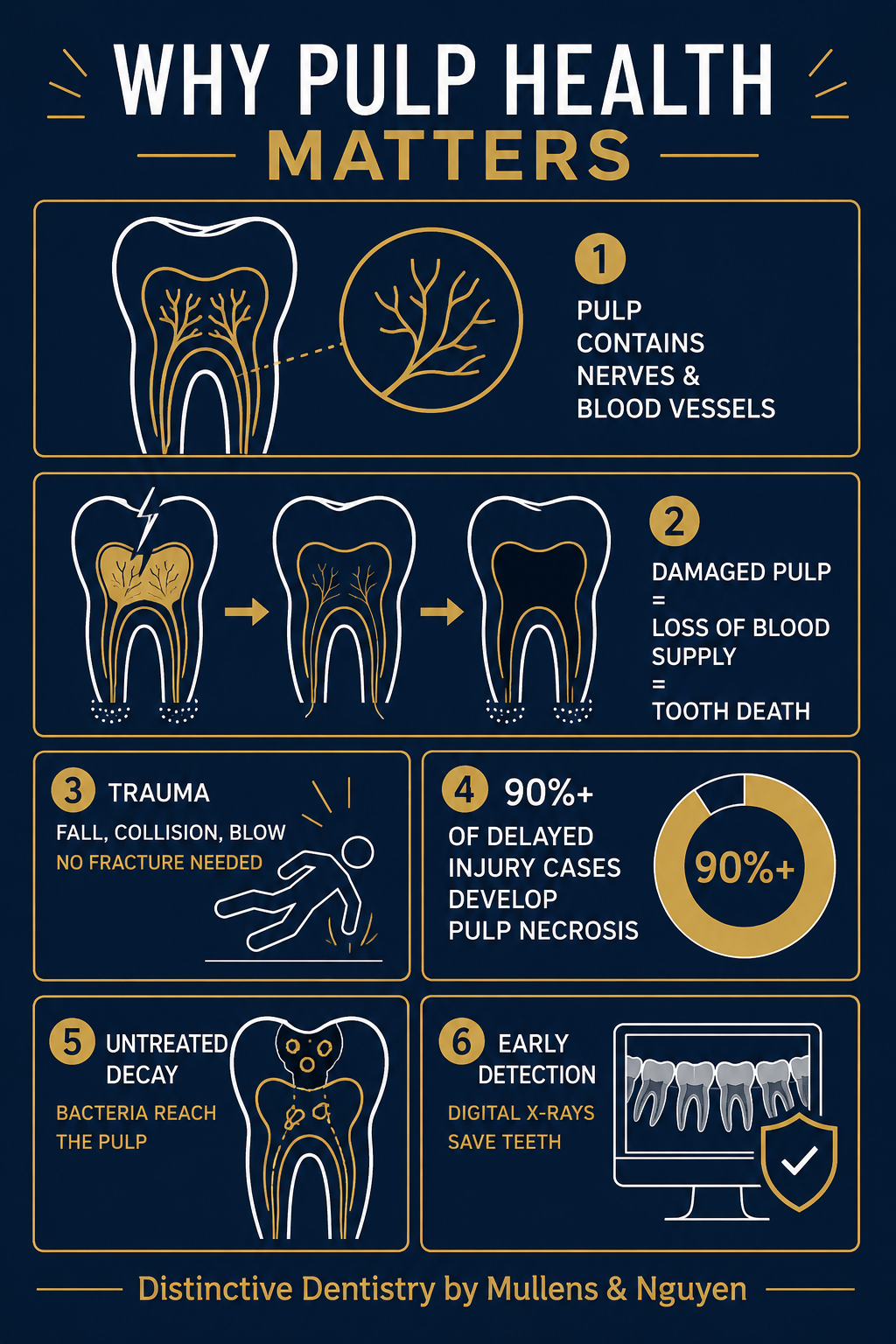
Every tooth contains pulp, a thin channel of nerve tissue and blood vessels that runs from the root tip to the crown and keeps the tooth alive. When that pulp is damaged and loses its blood supply, it can no longer sustain itself. The visible structure may stay intact for some time, but without nourishment or immune support, infection has an open path.
Two Primary Causes
Trauma is one path. A fall, a collision during a game, or a single blow to the face can rupture blood vessels inside a tooth without fracturing it. Nothing looks wrong afterward, and the tooth may feel completely normal for months. Dr. Mullens has treated patients who came in years after an injury, unaware that the tooth had been declining the whole time.
Research published in PubMed Central found that among patients who delayed treatment after traumatic dental injuries, pulp necrosis was the most common complication identified, appearing in more than 90% of affected teeth. That finding underscores why follow-up after any significant facial injury matters, even when the tooth feels completely normal.
Untreated decay is the other path. Bacteria work inward through enamel and dentin until they reach the pulp. Once infection takes hold, inflammation cuts off the blood supply, and the tissue begins to fail from the inside out. Our team uses digital X-rays, not older film-based systems, to catch these changes at the root level before symptoms surface.
Warning Signs to Recognize
A dying tooth does not always announce itself clearly, which is part of why it is worth knowing what to look for. Some symptoms are visible, others are felt, and some show up only on an X-ray during a routine visit.
Discoloration That Is Not Staining
A tooth that looks noticeably darker than the ones beside it is one of the clearest early signals. When blood vessels inside the tooth rupture, hemoglobin seeps into the surrounding dentin and gradually shifts the color. This is a different process from surface staining caused by coffee or tea, which affects the enamel from the outside. In trauma-related cases, a pink tint may appear first before the tooth progresses to gray or brown. Some patients notice this while brushing, assume it is a whitening issue, and put off follow-up for months.
Pain, Sensitivity, and Swelling
Some dying teeth produce no pain at all, which is part of what makes them easy to overlook. Others cause a spreading ache, biting sensitivity, or jaw tenderness that seems unrelated to any visible problem. A pocket of infection forming near the root tip, called an abscess, typically adds swelling at the gumline and a persistent bad taste that does not respond to brushing.
Signs that warrant a prompt exam include:
- A tooth that has darkened compared to the teeth around it
- Pressure or discomfort in the jaw that doesn’t trace to a visible cavity
- A bump or swelling along the gumline near a specific tooth
- A persistent bad taste or breath issue that doesn’t go away with regular hygiene
- A tooth that stopped reacting to cold or heat, where it once would
Not every one of these signals a dying tooth on its own, but each one warrants an evaluation with updated X-rays to get a clear answer. If you are experiencing several at once, an emergency dental evaluation sooner rather than later is the right call.
What Can Be Done
When our team confirms that a tooth is dying or already non-vital, the most common path to saving it involves removing the damaged tissue, thoroughly cleaning the root canals, sealing them to prevent reinfection, and restoring the tooth. Most teeth treated this way receive a dental crown afterward to protect the structure and restore normal function. A tooth that goes through this process can often be kept for years with no further issues.
When the damage is too extensive to save the tooth, replacing it with a dental implant is the option that most closely replicates the function of a natural tooth. Implants replace both the visible crown and the root beneath it, preserving bone and preventing neighboring teeth from shifting over time. Our team has helped many Jacksonville patients through this process, and the conversation always starts with what is actually happening in that specific tooth, not a generalized treatment path.
Distinctive Dentistry by Mullens & Nguyen: Restorative Care Built on Decades of Precision
Dr. Mullens, Dr. Nguyen, and Dr. Myers bring diagnostic depth from training in comprehensive, whole-bite dentistry. Dr. Mullens’s 35-plus years at this Jacksonville practice, combined with the Dawson Academy residency training both he and Dr. Nguyen completed, means the kind of gradual, quiet problem that a dying tooth represents is something our team is built to catch well before it becomes a bigger issue. Dr. Myers shares that same approach with every patient.
Catching a dying tooth early changes what treatment looks like and how much natural tooth structure can be preserved. If something about a tooth has been on your mind, even without a clear reason, that is worth investigating. Reach out through our appointment request form and let our team take a look.


