


Teeth whitening is one of the most popular cosmetic treatments available, and for good reason. When it works, the results are fast, affordable, and genuinely confidence-boosting. But not every case of discoloration responds to bleaching agents, and for patients who have tried whitening products without satisfying results, the frustration can be real. The good news is whitening trays and in-office bleaching are only one piece of a much larger picture, and cosmetic dentistry offers effective solutions for even the most stubborn stains.
At Distinctive Dentistry by Mullens & Nguyen, we approach smile aesthetics the way an artist approaches a canvas. The combination of Dr. Mullens’ three-decade legacy of clinical excellence and Dr. Nguyen’s fine arts background in sculpture means our team evaluates each case with both a clinical and creative eye. Whether discoloration stems from medication use, developmental conditions, or trauma, our cosmetic dentistry options in Jacksonville are designed to address the root cause rather than work around it.
Why Some Discoloration Does Not Respond to Whitening
Traditional whitening treatments work by using peroxide-based agents to break down surface-level and shallow subsurface stains. When discoloration is extrinsic, meaning it originates from outside the tooth due to coffee, tea, tobacco, or food pigments, whitening is often highly effective. The challenge arises with intrinsic discoloration, which originates within the enamel or underlying dentin and cannot be reached by topical bleaching agents.
Common Causes of Whitening-Resistant Discoloration
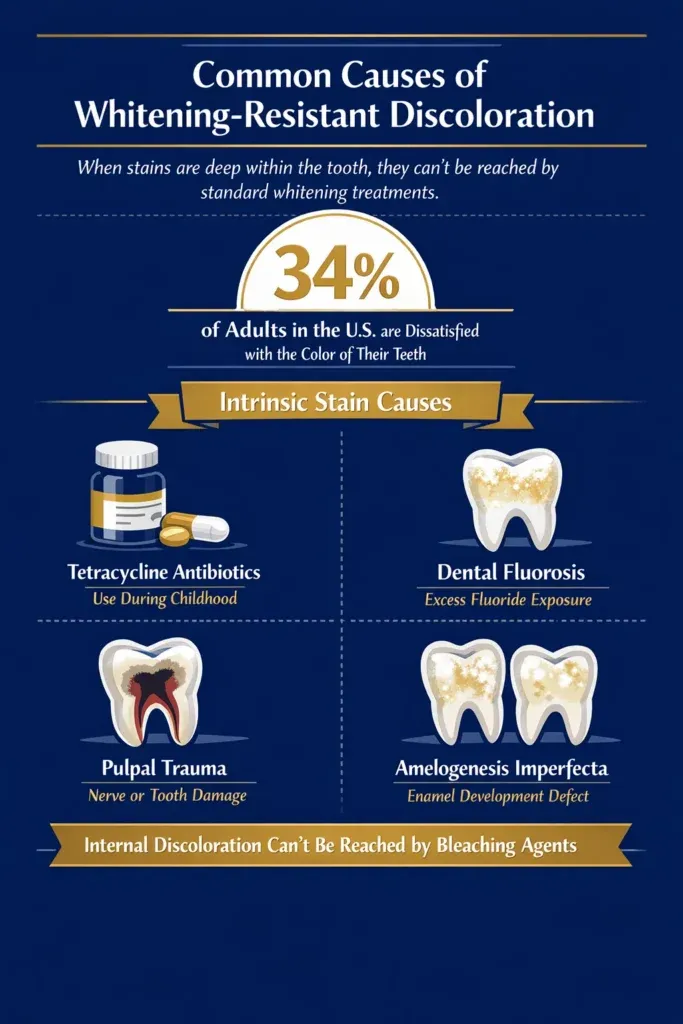
Research published in BMC Oral Health found that 34% of adults in the United States are dissatisfied with the appearance or color of their teeth, yet standard bleaching agents are simply not designed to address every type of discoloration. When staining originates within the enamel or underlying dentin rather than on the surface, peroxide-based products cannot reach it. Common causes of this type of intrinsic discoloration include tetracycline antibiotic use during childhood, dental fluorosis, pulpal trauma, and amelogenesis imperfecta, all of which form within the tooth structure during development or as a result of internal changes over time.
Cosmetic Solutions That Actually Work
When whitening reaches its limits, cosmetic dentistry provides alternatives built for exactly these situations. The right treatment depends on the extent and type of discoloration, the overall condition of the teeth, and each patient’s aesthetic goals.
Porcelain Veneers
Porcelain veneers are one of the most versatile and effective solutions for intrinsic discoloration. Thin shells of high-quality porcelain are bonded to the front surfaces of the affected teeth, completely masking discoloration while simultaneously improving shape, size, and symmetry. Because they cover the visible surface entirely, veneers are able to address even severe fluorosis staining, tetracycline discoloration, and developmental irregularities that no bleaching protocol can touch. Dr. Nguyen’s artistic background plays a central role in veneer design, ensuring each restoration blends naturally with the surrounding smile. Our smile makeover consultations are a natural starting point for patients exploring comprehensive aesthetic transformation.
Composite Bonding
For patients with more localized discoloration or smaller affected areas, composite bonding offers a minimally invasive alternative to veneers. Tooth-colored composite resin is applied directly to the affected surface, shaped, and cured to create a seamless match with surrounding teeth. The procedure is typically completed in a single visit and requires little to no removal of natural tooth structure, making it an appealing option for patients who want meaningful improvement without a significant time or financial commitment.
Dental Crowns
When a tooth is severely discolored and also structurally compromised, a dental crown addresses both concerns at once. Crowns encase the entire visible portion of the tooth above the gumline, restoring aesthetics and strength simultaneously. This approach is particularly well-suited for teeth with deep intrinsic staining alongside chips, cracks, or decay. Our team coordinates these cases carefully with the broader treatment plan, including any related restorative work such as dental implants when tooth loss is also a factor.
Veneers vs. Bonding: Which Is Right for Whitening-Resistant Stains?
Patients frequently ask how to choose between veneers and bonding once whitening has been ruled out. Bonding is generally the more conservative and budget-friendly option, and it works well for isolated spots of discoloration or a single stubborn tooth, but the composite material can pick up new stains over the years and may need touch-ups sooner than porcelain. Veneers involve a small amount of enamel reduction in most cases and a higher upfront investment, but porcelain resists staining far better over time and can address discoloration across an entire smile at once with a more uniform, long-lasting result. Patients with widespread fluorosis or tetracycline staining across many teeth are often better served by veneers, while a single discolored tooth from an old injury may be a good candidate for bonding alone. A side-by-side comparison during a consultation, including photos of both options, is the most reliable way to decide.
How Long Do Cosmetic Solutions for Discoloration Last?
Porcelain veneers typically last 10 to 15 years or longer with proper care, and their stain-resistant surface means the color achieved on day one tends to hold steady for the life of the restoration. Composite bonding generally lasts 5 to 7 years before it needs to be refreshed or replaced, since the resin is more porous than porcelain and can gradually pick up stains from coffee, tea, or tobacco. Dental crowns used to address discoloration alongside structural damage often last 10 to 15 years as well. In every case, avoiding teeth grinding, wearing a nightguard if needed, and keeping up with routine cleanings extends the life of any cosmetic restoration.
What to Expect at Your Consultation
Identifying the right solution for whitening-resistant discoloration begins with a thorough evaluation. Our office uses advanced diagnostic technology, including intraoral cameras and digital X-rays, to assess not only the visible appearance of the teeth but their underlying structure as well. This ensures the recommended treatment addresses the true source of the problem rather than simply masking the surface.
Patients are never pushed toward a single solution without a full review of what each option involves, including realistic timelines, expected outcomes, and investment.
Restore Your Smile at Distinctive Dentistry by Mullens & Nguyen
Discoloration that has not responded to whitening does not mean you are out of options. At Distinctive Dentistry by Mullens & Nguyen, Dr. Mullens and Dr. Nguyen have helped countless Jacksonville patients achieve the bright, even smile they had stopped believing was possible. Our brand-new, state-of-the-art facility and commitment to treating every patient like family mean you will always receive care that is thorough, personalized, and focused entirely on your goals.
If you are ready to find out which cosmetic solution is right for your smile, request an appointment today. We will take the time to understand your concerns, walk you through your options, and build a treatment plan designed to deliver results you will love for years to come.
Frequently Asked Questions About Cosmetic Solutions for Discolored Teeth
Why won’t my teeth get whiter no matter what I try?
If your discoloration comes from within the tooth structure rather than the surface, no whitening product, in-office or at-home, can reach it. This type of intrinsic staining requires a cosmetic solution such as veneers, bonding, or a crown rather than additional bleaching.
Are veneers or bonding better for whitening-resistant stains?
Veneers tend to work better for widespread discoloration across multiple teeth and offer superior long-term stain resistance, while bonding is a more conservative, budget-friendly option for a single discolored tooth or a small area. Your dentist can recommend the best fit based on the extent of your staining.
Is treatment for intrinsic tooth discoloration painful?
Most cosmetic treatments for discoloration, including bonding and veneers, involve little to no discomfort. Local anesthesia is used when any enamel reshaping is needed, and most patients describe the process as comfortable with only mild, short-lived sensitivity afterward.
How many appointments does treatment usually take?
Composite bonding is often completed in a single visit. Porcelain veneers typically require two visits, one for preparation and impressions and a second to bond the finished veneers, while a dental crown generally follows a similar two-visit timeline unless a same-day option is used.
Will insurance cover cosmetic treatment for discolored teeth?
Purely cosmetic treatment is often not covered by dental insurance, though cases involving structural damage, such as a crown needed for a cracked or decayed tooth, may qualify for partial coverage. Our office can help review your specific plan and estimate out-of-pocket costs before treatment begins.


